 |
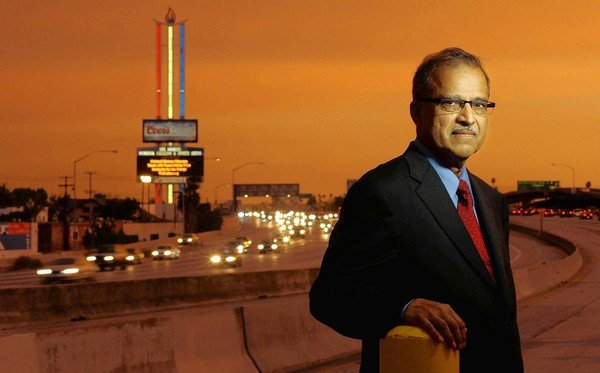
| Pervaiz Lodhie, who owns an LED lighting business in Torrance, stands along the 110 Freeway near the Los Angeles Memorial Coliseum & Sports Arena sign.(Wally Skalij, Los Angeles Times / June 9, 2013) |
Driving past the sign on the 110, Pervaiz Lodhie — the owner of an LED
lighting business — decided its flickering fluorescent tubes needed to
be replaced. So he donated thousands of dollars' worth of bulbs.
By Bob Pool, Los Angeles Times
He was headed downtown, traveling along the 110 when — just like in
the cartoons — a light popped on over Pervaiz Lodhie's head.
If this city truly wants to improve the look of the busy industrial landscape,
he decided, it should at least replace the burned-out and flickering fluorescent
tubes in the Los Angeles Memorial Coliseum & Sports Arena sign that towers
160 feet above the freeway.
Lodhie then went a step further. He agreed to supply the light bulbs.
Lodhie, who owns a Torrance-based LED lighting business, made the commitment
when he met with representatives of Mayor Antonio Villaraigosa in early 2011
to discuss development of a "green corridor" between downtown Los
Angeles and the harbor.
"I said it's a sign that is supposed to be iconic, but year after year
it just looks uglier and uglier," said Lodhie, 69. "I made a passing
remark saying I wouldn't have a problem donating replacement LED tube lights
for it."
The mayor's representatives passed word of Lodhie's offer to the sign's owner,
the Coliseum Commission, which quickly took him up on it.
"I thought that the sign had maybe 20 or 30 tubes," Lodhie said.
One hundred and fifty or so light bulbs later, Lodhie filled the order at
no charge, shipping thousands of dollars' worth of LED lights in August to
Coliseum operators.
Each of the tubes — some 8 feet long, some 6 feet and several 3 feet — contains
500 tiny light-emitting diodes mounted on a long chip board. As corroded sockets
in the sign were replaced, the new bulbs were installed. The makeover was completed
in December.
Designed to draw attention to events at the Coliseum and in the Sports Arena,
the sign also features an electronic billboard. Its three legs, which shine
in red, white and blue, are crowned by a symbolic "flame" that is
reminiscent of the caldron atop the Coliseum's peristyle entrance.
Lodhie said his bulbs were installed in the billboards and the sign legs but
were not attached to the flame symbol on top.
"I'm trying to find out why that flame isn't on. Maybe it's only turned
on when the Olympics are here," he speculated. (Coliseum officials say
the sign's flame has never been lighted.)
Located at South Grand Avenue and West 39th Street, the sign was constructed
for the 1984 Olympic Summer Games, according to officials.
Pakistani-born Lodhie started his 125-employee manufacturing company, LEDtronics
Inc., with his wife, Almas, in 1983 in the garage of their Torrance home. He
said he made his first miniature LED lamp in 1972, when light-emitting diodes
were mostly used for things such as elevator buttons and broadcast console
switches.
"Back then, they were never appreciated," he said of the tiny bulbs. "They
were invisible."
These days LEDs are commonly used in homes, street lamps and traffic signals
and as automobile brake lights. Although pricier than incandescent light bulbs
and fluorescent tubes, they tend to last much longer and require less electricity.
Robert Joyner, the Coliseum Commission's head of stadium operations and special
projects, has calculated that the LED bulbs have cut the sign's power consumption
by more than 28%, even though the previous fluorescent lights were relatively
economical and many of them had already burned out by the time they were replaced.
Lodhie predicts that the savings will eventually register above 50%.
The Coliseum sign bulb donation isn't Lodhie's first giveaway. He also produces
solar-powered LED lanterns that he provides for free in Pakistani villages
that lack electricity.
"That changes families' lives at night," he said. "And it does
away with the pollution that comes with kerosene lamps."